
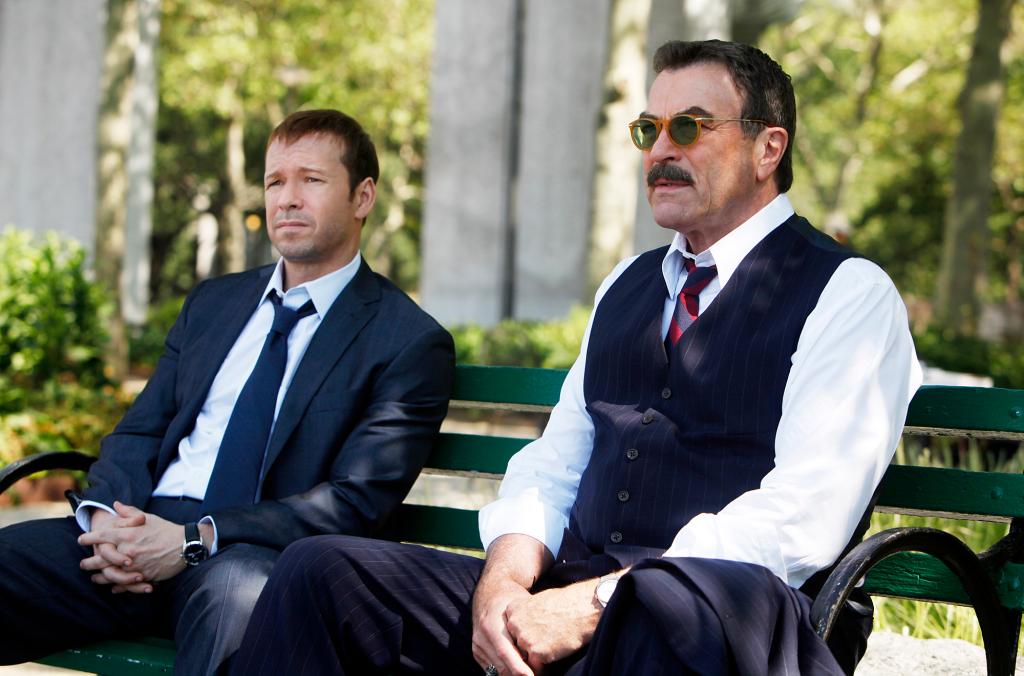
Tom Selleck reveals the ONE heartbreaking *Blue Bloods* episode he still can’t get over
CBS
Police procedurals can have a light-hearted edge every now and then — but most of the time, audiences are immersed in haunting, stirring, and often heartbreaking stories that shine a light on the world around us and the cruelties it can hide. When it comes to one of TV’s classic procedurals, “Blue Bloods,” star Tom Selleck’s favorite episode of the series is actually one of the show’s most emotional.
“The one that will always be my favorite is ‘The Job,’ in which you found out that [my character] Frank was in the World Trade Center’s North Tower on 9/11,” the actor told TV Insider in a March 2022 interview. The episode in question was the twelfth episode of season 2, which aired in February 2012.
“It was quite stirring because 9/11 was still fresh in people’s minds. It was hard for me to be strong as an actor, not to break down because Frank is tougher than that,” Selleck explained. “My friend F. Murray Abraham played a [psychologist, Leon Goodwin] but Frank doesn’t like psychologists. The episode winds up dealing with the people who got sick from being there at the time.”
In the episode, audiences are brought deeper into NYC police commissioner Frank Reagan’s personal life when he grapples with the death of his friend and former partner, who saved many New Yorkers at Ground Zero — but ultimately perished as a result of a chronic illness he contracted through the dangers of the wreckage.
CBS
“We were the first show allowed to show the Trade Center Memorial, right after it was finished,” Selleck told the outlet before adding, “It was written by Brian Burns, who just wrote the 250th [episode].”
Burns is a major part of why this episode is remembered for its impact. His writing was so effective that he was a finalist for the Humanitas Prize for this episode. The Humanitas Prize is a film and television award that “honors and empowers film and television writers whose work explores the human condition in a nuanced, meaningful way.” The Prize was founded over 50 years ago, and has since become a very prestigious piece of recognition for writers.
Selleck stuck with the show from the very beginning to the very end, closing out the show as Frank with season 14. CBS announced they were canceling “Blue Bloods” after 14 seasons in May 2024 (and we dug into why) despite the fact that the cast fought to keep their show going. The final season — in which original cast members Donnie Wahlberg, Bridget Moynihan, Will Estes, and Len Cariou also saw the series to the end alongside Selleck — aired from February to May 2024 and then came back for a second batch of episodes from October to December 2024.
Selleck’s final scene for the series was, too, an emotional one. The show ended with a final Reagan family dinner, one of its mainstay comforts. “Nobody wanted it to end,” he told Entertainment Weekly at the time. “It was all pretty emotional. … It was a blessing for 15 years. I mean, we had two families. We had the Reagan family that we portrayed, and quite quickly we had this family of actors who all actually liked each other, which never happens in television.”
HBO
Ah, the boob tube — the omnipotent provider of all things entertainment. Sports, comedy, action, drama — it’s all there, neatly packaged on streaming platforms, waiting to be discovered after a long day at work. Who doesn’t look forward to kicking back with an episode of “Seinfeld,” or diving into the sweeping melodrama of “Outlander”?
Or maybe you’d prefer a wicked detour into the macabre, where beheadings, executions, and baseball bat bludgeonings await?
Wait, what?
Yes indeed, television — especially in the last decade or so — has grown increasingly repulsive in its content, serving up a steady supply of shocking violence that seems to grow more absurd with each passing year. In case you don’t believe us, we’ve cobbled together a list of the most disturbing television scenes of all time, ranked in no particular order. Fair warning: Many of these are not for the faint of heart, and, of course, spoilers lie ahead.
HBO
The “Red Wedding” episode of “Game of Thrones,” as it’s known — though its actual title is “The Rains of Castamere” — remains one of the most shocking moments in TV history (and one of the best episodes of the HBO series, sparking unforgettable fan reactions around the world).
Late in Season 3, Robb Stark (Richard Madden) attends a wedding at House Frey, despite having broken his pact with the Freys by marrying Talisa Maegyr (Oona Chaplin). Walder Frey (David Bradley), enraged by Robb’s betrayal, lures the Starks into a trap that culminates in the brutal slaughter of Robb, Talisa, Catelyn Stark (Michelle Fairley), and countless Stark loyalists. And by brutal, we mean brutal. Guests are riddled with arrows, a very pregnant Talisa is stabbed in the belly, Robb is stabbed in the heart, and Catelyn has her throat slit. Later, in one of the show’s cruelest images, Robb’s corpse is paraded with his direwolf’s head sewn onto his body.
No one expected the story’s noble young hero to meet such a mean-spirited, unheroic end. (Well, unless you read the book.) Even now, the Red Wedding lingers like a bad dream we’d rather forget.
AMC
Sometimes a disturbing scene doesn’t require gore or bodily horror. In the case of “Breaking Bad,” Walter White (Bryan Cranston) lets Jesse’s (Aaron Paul) drug-addicted girlfriend Jane (Krysten Ritter) die in a revolting scene that cemented his character firmly in evil territory for good.
In the scene, Walt enters Jesse and Jane’s residence and finds the pair passed out after a fun-filled night of heroin. Jane, lying on her back, suddenly begins vomiting, too doped to wake up. At first, Walt moves to assist her, but then his cold, calculating nature takes over — after all, Jane was complicating matters between him and Jesse. He backs away, watches her choke to death in her sleep, and then exits the way he came in.
Yeah, it’s a pretty intense death scene. Walt was once a morally sound man living a quiet life with his wife and son. As much as we cheered on his transformation into the legendary Heisenberg, his inaction in this sequence exposed the darkness lingering below the harmless facade and left us staring at an unrecognizable monster.
AMC
Every TV show eventually “jumps the shark,” a term used to describe an over-the-top moment that signals the beginning of a series’ decline in quality. For “The Walking Dead,” that moment came with the arrival of Negan (Jeffrey Dean Morgan), which pushed the zombie drama too far into the absurd — and into a ratings slump from which it never fully recovered.
The baseball bat-wielding villain arrives at the end of Season 6 and, much like his comic book counterpart, brutally murders a key character. Comic readers dreaded this moment, knowing it would mean the end for fan favorite Glenn (Steven Yeun). Still, the show stretched the suspense, withholding the reveal until the Season 7 premiere — where Negan first kills Abraham (Michael Cudlitz) in brutal fashion.
Then, without warning, he turns and smashes his bat into Glenn’s head, leaving the beloved character with a crushed skull and bulging eye. It’s a horrific, gruesome end for one of the series’ most important heroes — and the point where many viewers tapped out. Who can blame them? After several strong seasons, it appeared the showrunners were now more reliant on cheap, gory gimmicks than powerful storytelling. No thanks.
Amazon Studios
Of course “The Boys” would make an appearance on this list. The Prime Video series prides itself on shocking carnage to reel in audiences, and happily walks — and often crosses — the fine line between dark, twisted humor and mean-spirited mayhem. One need only watch — or avoid — the Season 3 premiere to see the lengths show creator Eric Kripke will go to get a laugh.
In the episode titled “Payback,” a hero named Termite (Brett Geddes) — a parody of Ant-Man — shrinks down and crawls inside his male partner’s penis for sexual stimulation. The duo had consumed a large amount of cocaine beforehand, and when Termite sneezes with residue still on his nose, he loses control of his size. In an instant, he expands back to full human form, exploding his partner from the inside out.
It’s a grotesque sequence that leaves Termite drenched in blood and entrails. And while we can chalk it up to another deliberately outrageous “Boys” moment, it’s also deeply disturbing.
FX
Leave it to “American Horror Story” to ride into incredibly bleak (though topical) terrain — school shootings — to freak us out. Indeed, a Season 1 episode is devoted entirely to Tate Langdon (Evan Peters), a troubled, charismatic teenager who initially comes across as misunderstood but quickly reveals the darker nature of his character.
During the sixth episode, titled “Piggy Piggy,” we see that Tate murdered 15 students at Westfield High before a SWAT team took him out. Now a ghost bound to the titular murder house, Tate is a walking example of innocence corrupted by violence and mental illness. While we don’t see a graphic, blow-by-blow account of the massacre, we see snippets via flashback of Tate calmly walking through the school hallways with a shotgun and revolver, entering classrooms, and executing students with cold detachment.
The uptick in school shootings and political violence makes “Piggy Piggy” even more difficult to watch, knowing that it exemplifies the often-cruel world we inhabit.
Lionsgate Television
Watching people suffer ranks pretty low on the entertainment spectrum. And yet, sometimes a show is so compelling you can’t look away from the ghastly images on screen. Such is the case with Showtime’s “Yellowjackets,” a gripping drama about a girls’ soccer team that crash-lands deep in the Canadian wilderness on their way to a national tournament. Bouncing back and forth between the present day and their desperate fight for survival in 1996, the series often forces its characters to confront the worst of nature — and each other.

In Season 1, Episode 7 (“No Compass”), Vanessa “Van” Palmer (Liv Hewson) is attacked by wolves during a nighttime expedition. The animals maul her face, tearing open her cheek in grisly fashion. Rather than let their friend die, the other girls crudely stitch her wound back together with makeshift tools — and yes, it’s every bit as graphic and unbearable as it sounds. The moment highlights both the teens’ resourcefulness and the terrifying lengths they’re forced to go to in order to survive. Just listening to Van’s agonized screams is enough to induce nightmares.
Lynch/Frost Productions
No blood. No gore. Just a simple shot of a man named BOB (Frank Silva) casually walking into a room, turning, and crawling over a couch until his face presses right up against the screen — a wide grin plastered across his face, his movements almost unnatural. There’s no buildup, just a sudden violation of domestic bliss by a madman, in broad daylight, no less.
Welcome to the classic TV series “Twin Peaks,” a psychological drama centered on the mysterious death of high school homecoming queen Laura Palmer (Sheryl Lee). The scene with BOB occurs in Episode 2 of the first season, and immediately signals that something more sinister — and perhaps supernatural — is tied to Laura’s murder. Is BOB real, or a manifestation of something darker within the Palmer household?
Like many of David Lynch’s greatest scares, the couch scene is psychological. The horror lies in how casually BOB approaches, closing the distance between himself and the viewer until that final jolt delivers a hefty dose of the heebie-jeebies.
Fox
The “X-Files” episode “Home” (Season 4, Episode 2) remains one of the most disturbing hours of network TV ever produced. In today’s world, graphic violence on television feels almost commonplace. In the mid-’90s, it was downright abhorrent.
This self-contained story follows Mulder (David Duchovny) and Scully (Gillian Anderson) as they investigate the Peacock family, three hostile brothers holed up in a crumbling Pennsylvania farmhouse. Eventually, they discover that the brothers have been engaging in incest with their mother to preserve the family bloodline — just another day at the office for our FBI duo.
Except Mrs. Peacock (Karin Konoval) is a horribly disfigured quadruple amputee who lives under a bed and moves around on a rolling board. The sight of her suddenly revealed beneath the bed will make audiences shriek — it’s freaky, surreal, and unforgettable, even by “X-Files” standards.
To make matters worse, the episode opens with a savage murder sequence set to the cheerful tune “Wonderful! Wonderful!” Across hundreds of episodes featuring UFOs, aliens, and monsters, the Peacocks stand as the series’ most chilling encounter.
Pony Canyon
Yes, even animated shows can dip into incredibly dark territory. The anime “Attack on Titan” follows a group of young adults as they attempt to protect their homeland from giant, humanoid Titans. These strange beings move at a sluggish pace and carry vacant expressions that make them about as inviting as a colonoscopy. They’re also incredibly brutal, consuming humans as though munching on a corndog.
We see the Titans’ ferocity right away in the very first episode, when Eren Yeager (Yūki Kaji/Bryce Papenbrook) and his foster sister Mikasa Ackerman (Yui Ishikawa/Trina Nishimura) witness a Titan attack. Their mother, Carla (Yoshino Takamori/Jessica Cavanagh), is trapped under debris as the Smiling Titan closes in. Soldier Hannes (Keiji Fujiwara/David Wald) tries to help but flees with the children, leaving Eren to watch helplessly as his mother is eaten alive.
The execution of the scene is melodramatic, forcing us to endure each and every chomp while a horrified child watches from a distance. It’s not just the gore, but the emotional cruelty; the helplessness of Eren, powerless to save his mother, sets the tone for the entire “Attack on Titan” series.
Amazon Studios
Another scene from “The Boys” worthy of this list is when Homelander (Antony Starr) fully reveals his true colors. The Superman wannabe teams up with Queen Maeve (Dominique McElligott) to stop terrorists who hijack a commercial flight. Once onboard, Homelander easily kills the hijackers but accidentally destroys the cockpit controls with his heat vision. With no way to steer the plane, he decides to abandon it — and the passengers — to their fate. Maeve pleads with him to at least save a handful of lives, but he coldly refuses. His reasoning? Saving only a few would make them look weak. Eesh.
Vacating the aircraft, the pair leaves behind terrified, screaming passengers and watches as the plane plunges into the ocean, killing everyone on board. It remains one of the most disturbing sequences in “The Boys” because it exposes Homelander’s calculated ruthlessness and complete lack of humanity — while also upending our expectations about superheroes. For a fleeting moment, everyone, including a little girl, believes Homelander has come to save the day like a traditional hero. Moments later, that same girl spends her final seconds clinging to her mother, realizing her so-called savior has abandoned her.
NBC
The craziest part about the disturbing content in the critically acclaimed series “Hannibal” is that it aired during NBC’s primetime slot, which is unusual for a show containing so much violence and gore. Loosely based on Thomas Harris’ Hannibal Lecter novels, the series explores the relationship between the famed cannibalistic doctor Hannibal Lecter (Mads Mikkelsen) and FBI profiler Will Graham (Hugh Dancy). Initially presented as a killer-of-the-week-style series, “Hannibal” eventually evolved into a captivating (and bizarre) character study that unfortunately never attracted enough of an audience.
Still, the early episodes didn’t shy away from nasty images. Most prominently baked into our memories is the scene in Season 2, Episode 2 (“Sakizuke”) where Roland Umber (Ryan Field) wakes up to find himself sewn into a human mural of corpses. Over the next several minutes, he slowly pries himself away, ripping his skin and flesh in the process; just thinking about it makes our stomach turn. It’s grotesque body horror dialed up to 11, and one of the most memorable visuals in the entire series.
Fox
The “House M.D.” Season 3 episode “Insensitive” sees our beleaguered title doctor (Hugh Laurie) treating a teenage girl named Hannah (Mika Boorem), diagnosed with CIPA (Congenital Insensitivity to Pain and Anhidrosis) — meaning, she can’t feel pain. Her symptoms range from high fevers to faltering organs, forcing House to conduct various tests to determine the cause of her condition.
Well, after a last-second epiphany, House rushes to her surgery bed, cuts the teen open, and extracts a 25-foot tapeworm. Like something out of “Alien,” the nasty creature has been feasting on Vitamin B12 directly from her digestive tract before her body can use it, explaining her neurological problems and organ issues.
The show gleefully makes us watch the full, bloody extraction, which the patient is awake to see, by the way. Hilariously, the other doctors — Foreman (Omar Epps), Cameron (Jennifer Morrison), and Chase (Jesse Spencer) — take photos on their phones, stunned by the creature’s length. When all is said and done, the final tally: “Twenty-five feet long.”
“Dammit,” House says, “the world record is 60.”
Now, who wants some spaghetti?
HBO
The most egregious example of “Game of Thrones” having a propensity for shocking violence is the moment noble Oberyn Martell (Pedro Pascal) faces off against the Mountain (Hafþór Júlíus Björnsson) — and winds up without a face. To keep it simple: Oberyn agrees to fight on behalf of Tyrion Lannister (Peter Dinklage), which pits him against the dreaded Mountain. At first, the duel seems one-sided, but the Mountain’s lumbering fighting style is no match for Oberyn’s speed and precision. He even knocks the giant flat on his back. Victory appears imminent.
Instead of finishing the job, Oberyn circles his fallen opponent, demanding that he confess to the rape and murder of his sister Elia Martell and the killing of her children. This hesitation proves fatal. The Mountain seizes the opportunity, trips Oberyn, and pins him to the ground. In one of the most shocking visuals of the entire series, he drives his thumbs into Oberyn’s eyes and crushes his skull like a ripe melon. (Don’t worry, Pascal was sleeping during this bit.)
No, it’s not quite as disturbing as the Red Wedding — by this point, many of us were already numb — but Oberyn’s brutal death still induces shudders and remains one of the hardest “Game of Thrones” moments to watch.
HBO
In the opening episode of the “Game of Thrones” spin-off “House of the Dragon,” Queen Aemma Arryn (Sian Brooke), wife of King Viserys I Targaryen (Paddy Considine), goes into labor during a jousting tournament. Complications arise, leading the Grand Maester to suggest a crude C-section to save the baby. The procedure will almost certainly kill the mother, leaving Viserys to choose between the woman he loves and the heir he desperately wants. Duty to the realm forces his hand, and here’s the really nasty part: Aemma has no idea what’s about to happen. Instead, she has her arms bound while the doctors do their worst. Slowly, the child is cut from her womb, and we see it all in harrowing detail. Gah.
This was definitely one of those moments we could only watch through our fingers, and apparently, it drew enough criticism to tick off series star Emma D’Arcy. Oh, and in case you’re wondering, the baby doesn’t survive.
FX
Finally, “The Americans” gets in on the fun thanks to the Season 3 episode “Baggage,” in which Elizabeth Jennings (Keri Russell) and Yousaf (Rahul Khanna) go to extreme lengths to, uh, fix a big problem — namely, disposing of a corpse.
Yousaf, a Pakistani intelligence officer, had been sleeping with Annelise (Gillian Alexy), an informant who used her charm to manipulate men and gather intel. The Jennings recruited her to get close to Yousaf, but things went sideways when she actually fell for him and confessed her role in the operation. Enraged, Yousaf retaliated by strangling her to death — a shocking turn first revealed in the prior episode, “EST Men.”
That left Elizabeth with cleanup duty. In one of the show’s most disturbing sequences, she methodically folds Annelise’s body into a suitcase, snapping bones so it will fit. It’s the kind of grotesque work you’d expect from villains, yet here we see our protagonists tap into their darkest instincts, all in the name of the “greater good.” Yikes.