
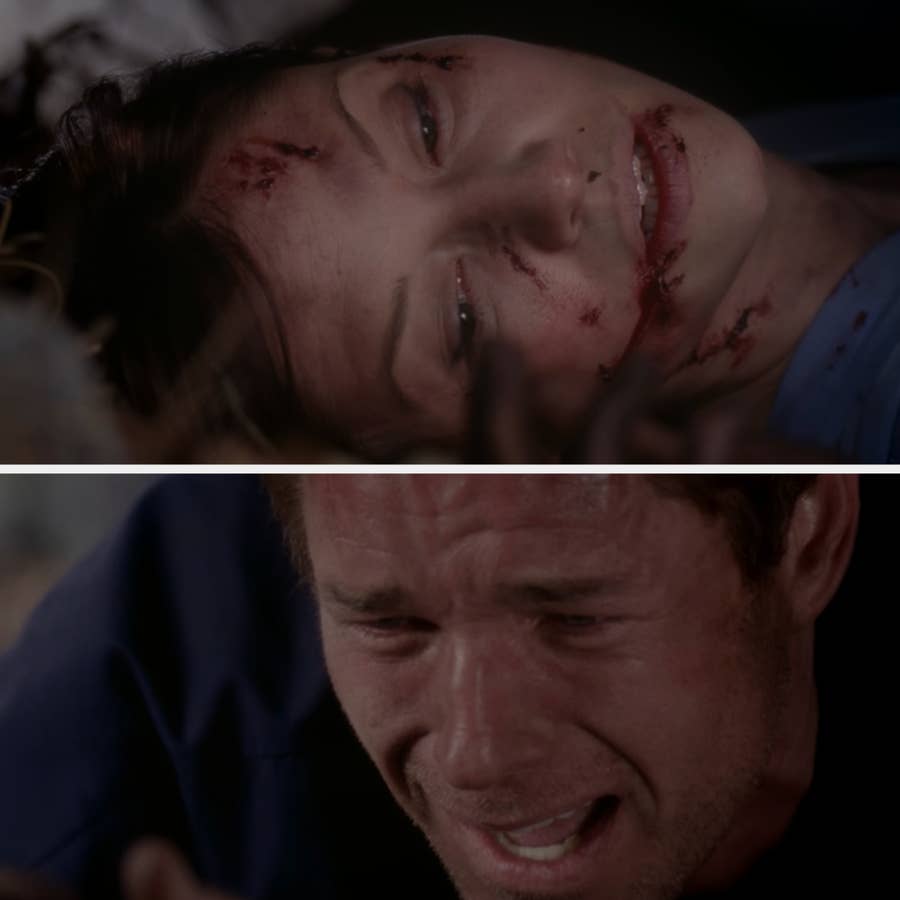
Grey’s Anatomy Just Delivered A Heartbreaking Twist That Has Fans In Tears!
For over two decades, one television drama has stood as an undisputed titan of network entertainment: Grey’s Anatomy. Since its premiere in 2005, Shonda Rhimes’ flagship medical drama has transcended the boundaries of a standard television show to become a cultural touchstone.
While other long-running series often lose their momentum, burning out or fading into obscurity, Grey’s Anatomy continues to deliver the emotional moments fans love. Whether it is a devastating loss in the OR, a bittersweet romantic reunion, or a poignant monologue about resilience, the halls of Grey Sloan Memorial Hospital (formerly Seattle Grace) remain an emotional battleground where millions of viewers willingly sacrifice their tears every single week.
But how does a show manage to maintain its emotional chokehold on a global audience for over twenty seasons? The answer lies in its masterclass approach to character development, its fearlessness in tackling human tragedy, and its unique ability to evolve with its audience.
To understand why Grey’s Anatomy continues to strike a chord with fans, one must dissect the unique narrative formula developed by Shondaland. It isn’t just about the medical anomalies or the high-stakes surgeries; it is about the flawed, deeply human individuals wielding the scalpel.
There is a specific phenomenon attached to Grey’s Anatomy that fans often refer to as “comfort bleakness.” The show has created a safe space for viewers to process profound grief, anxiety, and joy. By watching characters like Meredith Grey, Miranda Bailey, and Richard Webber navigate catastrophic life events, the audience finds a cathartic release for their own real-world emotions.
From the very beginning, the interns, residents, and attendings of Seattle Grace were never painted as saints. They are brilliant but arrogant, loving but selfish, heroic but deeply damaged.
Meredith Grey: The poster child for “dark and twisty.”
Cristina Yang: Unapologetically ambitious and emotionally guarded.
Alex Karev: A defensive bully who transformed into a fiercely loyal pediatrician.
Because these characters are allowed to make monumental mistakes, their triumphs feel earned, and their heartbreaks feel profoundly personal to the viewer.
When fans think of Grey’s Anatomy, they immediately recall specific milestones that redefined emotional storytelling on television. The longevity of the series is anchored by these massive, structural narrative shifts that shattered the status quo.
Each of these historic milestones set a precedent: Grey’s Anatomy would never play it safe. The show taught its audience that healing is a non-linear process, a theme that resonates just as strongly in its latest seasons as it did in the golden era of the 2000s.
A common critique leveled at long-running dramas is that they run out of steam, relying on cheap gimmicks or repetitive storylines. However, Grey’s Anatomy has defied the odds by successfully passing the torch to new generations while keeping its foundational pillars intact.
In recent seasons, the introduction of a new batch of messy, ambitious, and vulnerable interns has breathed fresh life into Grey Sloan Memorial. Showrunners intentionally mirrored the chaotic, competitive, yet deeply bonded energy of the original M.A.G.I.C. (Meredith, Alex, George, Izzie, Cristina) intern class.
Watching these young doctors make their first critical mistakes, fall in love in the on-call rooms, and lean on each other during losses reminds veteran fans exactly why they fell in love with the show in the first place.

Nostalgia is a powerful emotional currency, and Grey’s Anatomy handles it like a currency mastermind. The creative choice to bring back iconic characters—whether through Meredith’s Covid-induced beach dream sequences (featuring Derek, George, Lexie, and Mark) or guest appearances by Jackson Avery and April Kepner—serves as a beautiful reward for long-term viewer loyalty. These moments act as an emotional bridge, linking the show’s storied past with its ongoing present.
The emotional delivery of Grey’s Anatomy isn’t accidental; it is a finely tuned cinematic machine. The show utilizes a distinct combination of three elements to maximize the emotional impact of its scenes.
It is impossible to talk about Grey’s Anatomy without mentioning its music. The show single-handedly launched or boosted the careers of artists like Snow Patrol, The Fray, and Brandi Carlile.
“Chasing Cars” by Snow Patrol is no longer just a song; to a Grey’s fan, it is an auditory trigger for profound sorrow.
Whether it is the haunting acoustic covers of classic pop songs or the triumphant swells during a successful ground-breaking surgery, the soundtrack acts as the emotional heartbeat of every episode.
Every episode is bookended by a philosophical voiceover, usually delivered by Meredith Grey. These monologues frame the medical theme of the episode as a metaphor for human psychology and relationships. They provide a comforting, reflective space that allows the audience to digest the heavy emotional themes of the episode.
The medical cases of the week are rarely just about the biology. They are carefully selected to reflect the internal struggles of the doctors treating them. When a patient is struggling to let go of a toxic relationship, a doctor on the case is usually dealing with the exact same issue in their personal life. This dual-layered storytelling doubles the emotional payoff of every single diagnosis.
In the era of streaming, where shows are canceled after one or two seasons, the enduring loyalty of the Grey’s Anatomy fandom is an anomaly. This loyalty stems from a deep-seated connection that goes beyond standard television viewership.
For many viewers, they have spent over twenty years growing up alongside these characters. Fans who started watching as teenagers in high school are now navigating adulthood, careers, and families of their own, mirroring the life trajectories of Meredith, Bailey, and Richard. The show has become a reliable constant in an ever-changing world.
The internet has allowed the Grey’s fandom to transform into a massive global community. Social media platforms like TikTok, X (Twitter), and Reddit are constantly buzzing with discussions, fan edits of emotional scenes, and theories about upcoming episodes. Sharing the collective grief of a character’s departure or celebrating a long-awaited romantic reunion creates a sense of belonging among fans worldwide.

As Grey’s Anatomy continues its unprecedented run, the question on everyone’s mind is: how long can it keep delivering these top-tier emotional moments?
The answer seems to be: as long as human beings experience love, loss, and the desire to heal. The show’s core premise is inherently sustainable because medicine and human relationships are infinitely complex. By continuing to adapt to contemporary social issues, exploring modern medical breakthroughs, and allowing its characters to age and evolve realistically, Grey’s Anatomy ensures that its emotional well will never run dry.
Ultimately, Grey’s Anatomy continues to deliver the emotional moments fans love because it has never forgotten what it is at its core: a story about survival. It tells us that no matter how many times we are broken—by a lost love, a failed ambition, or a devastating tragedy—we can always pick up the scalpel, step back into the OR, and try again tomorrow.
As long as Grey Sloan Memorial Hospital keeps its doors open, fans will be right there, tissues in hand, ready to laugh, cry, and fall in love all over again.
Rate this post
Post Views: 69