
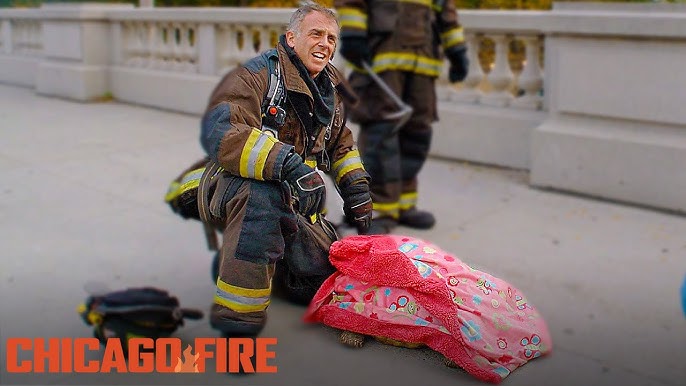
Firehouse 51 faces absolute chaos in their most shocking disaster yet—and no one is safe!
Chicago Fire: Kelly Severide’s Defining Ordeal – When Unyielding Courage Encounters Its Greatest Test
Firehouse 51 has long stood as a symbol of resilience amid Chicago’s most harrowing crises. The company has endured structural collapses, chemical incidents, and devastating losses that would fracture lesser teams. Yet the present emergency distinguishes itself through its sheer velocity and compounding dangers. What commenced as a standard response to an industrial alarm rapidly deteriorated into a cascade of structural failures, toxic releases, and imminent threats of larger-scale detonation. Within minutes, the coordinated efforts of the house dissolved into controlled chaos, with personnel deploying from every apparatus while command struggled to reestablish order.
At the center of this maelstrom stands Lieutenant Kelly Severide. For years, Severide has embodied the archetype of the firefighter who advances when others retreat. His reputation rests upon an instinctive ability to locate viable paths through impossible conditions and to extract victims others have already written off. Colleagues and civilians alike have come to regard him as the individual who always discovers a solution. On this occasion, however, the calculus appears altered. The scale of the blaze exceeds prior incidents, the environmental hazards introduce variables that defy standard protocols, and the potential human cost looms larger than any single operation in recent memory.
To comprehend the gravity of Severide’s position, one must examine the psychological architecture that has sustained him across seasons of service. Severide operates from a core conviction that inaction equates to moral failure. This belief traces its origins to formative losses, including the death of close comrades and the complicated legacy of his own father, a firefighter whose shadow he has spent a career both honoring and attempting to escape. Each successful rescue reinforces his identity; each failure, however statistically inevitable, lodges as a personal indictment. In quieter moments between calls, Severide has been observed reviewing incident reports long after others have departed, searching for procedural improvements that might prevent recurrence.
During the present operation, this internal mechanism operates at heightened intensity. As he surveys the expanding perimeter of the industrial complex, Severide’s thoughts cycle through competing imperatives. He registers the positions of his squad members, calculates the remaining air supply in their cylinders, and weighs the structural integrity of the compromised building against the known locations of trapped workers. Beneath these operational assessments runs a parallel current of personal calculation. He recalls the promise exchanged with his wife, Stella Kidd, that he would exercise measured judgment rather than reflexive heroism. The memory surfaces not as sentiment but as tactical data: returning home remains an explicit objective, yet the immediate demands of command threaten to render that objective secondary.
The environment itself amplifies these tensions. Thick smoke reduces visibility to mere feet. Unidentified chemical agents produce symptoms among exposed personnel that standard medical protocols do not fully address. Each decision Severide issues carries multiplicative consequences. Ordering an advance risks additional exposure; ordering withdrawal abandons viable victims. The lieutenant’s renowned composure masks the accumulating weight of these trade-offs. Observers close to him have noted subtle indicators—brief hesitations before transmitting orders, a tightening of the jaw when receiving reports of deteriorating conditions—that suggest the internal conflict has reached critical levels.
The crisis also exposes fault lines within the broader team dynamic. Firehouse 51 has historically functioned as an extended family whose members anticipate one another’s actions with near-telepathic precision. Under the present strain, that synchronization frays. Junior members look to Severide for signals that he cannot always provide with his customary speed. Senior officers debate tactical adjustments in real time, aware that any miscalculation may prove irreversible. Stella Kidd, positioned at a separate but adjacent sector, maintains operational focus while simultaneously monitoring Severide’s location through radio traffic. Their partnership, forged through years of shared peril and personal commitment, now operates under the additional pressure of mutual protection instincts that conflict with professional necessity.

Severide’s inner monologue, reconstructed from behavioral patterns established across prior incidents, reveals a man negotiating the boundary between admirable resolve and potential self-destruction. He recognizes that his willingness to absorb disproportionate risk has, on multiple occasions, preserved lives. He also recognizes that the same trait has placed colleagues in positions where they felt compelled to follow him into elevated danger. The present scenario crystallizes this paradox. If he advances alone to reach a trapped group, he may save them yet leave his own team without leadership at the moment they require it most. If he remains with the main body, he preserves command integrity but may forfeit the narrow window during which rescue remains feasible. The calculation is not abstract; it is visceral, immediate, and laden with the accumulated memory of every prior loss.
This psychological portrait gains additional resonance when placed against the thematic concerns that have animated Chicago Fire across its run. The series has consistently examined the cost exacted by sustained exposure to trauma. It has portrayed first responders who return home bearing invisible injuries that manifest in strained relationships, sleep disruption, and moments of unexpected emotional fracture. Severide has functioned as both exemplar and cautionary figure within this exploration. His capacity for rapid adaptation under duress has saved countless lives; his reluctance to acknowledge personal limits has, at times, isolated him from the very support structures that might mitigate long-term damage. The current emergency forces a confrontation with this duality at a scale the character has not previously encountered.
Audience engagement with the storyline reflects these layered stakes. Viewers who have followed Severide’s arc across multiple seasons recognize that his decisions carry narrative weight extending beyond any single episode. Speculation centers on whether the present crisis will exact a permanent toll—physical, emotional, or relational. Some anticipate a sacrificial act that would reconfigure the power dynamics of Firehouse 51. Others foresee a more nuanced outcome in which Severide survives yet must reconstruct his understanding of duty after confronting the boundaries of his own endurance. These interpretations arise from the show’s established pattern of balancing procedural spectacle with sustained character study. The possibility that Severide might pay the highest price resonates precisely because the series has invested years in demonstrating why such a price would matter to every other member of the company.
The narratve architecture of the present arc also invites consideration of broader questions about heroism in contemporary emergency services. Severide represents an ideal type: the individual whose competence and courage appear almost preternatural. Yet the storyline underscores that such ideals are sustained by human beings subject to fatigue, doubt, and the accumulating ledger of losses. When the environment exceeds the parameters that prior training anticipated, even exceptional operators confront the limits of preparation. The drama derives not from questioning Severide’s skill but from examining the moment when skill alone proves insufficient and character must supply the remainder.
Stella Kidd’s parallel storyline amplifies these themes. As a lieutenant in her own right, she navigates identical hazards while carrying the additional knowledge that her husband occupies the most exposed position. Their relationship has matured through prior trials into a partnership that respects professional autonomy while acknowledging personal stakes. The current operation tests that equilibrium. Kidd must trust Severide’s judgment even as every instinct urges her to intervene. Their eventual reunion, should circumstances permit it, will carry the accumulated tension of hours during which each operated with incomplete information about the other’s status.
In the aftermath of the immediate emergency, whatever form it ultimately assumes, Firehouse 51 will confront the task of integration. The company has historically demonstrated remarkable capacity for processing trauma through ritual, humor, and collective accountability. Yet the present event may demand deeper structural adjustments. Severide, should he remain in command, will carry forward an altered understanding of risk tolerance. The team will have witnessed both the necessity and the peril of his particular brand of leadership. These realizations may prompt recalibrations in training protocols, communication procedures, and the distribution of responsibility during large-scale incidents.
The storyline therefore functions on multiple registers simultaneously. It delivers the procedural intensity audiences expect from Chicago Fire while advancing a sustained meditation on the psychology of service. It honors the character’s established strengths while interrogating the sustainability of those strengths under escalating pressure. Most significantly, it invites viewers to consider the individuals behind the turnout gear—not as archetypes, but as people whose courage is inseparable from their capacity for fear, love, and doubt.
As the narrative continues to unfold, the central question remains not merely whether Severide will prevail in the immediate tactical sense, but what form of victory remains possible when every available path exacts a measurable cost. The series has built its reputation upon refusing easy answers to such questions. In this instance, the refusal promises to yield one of the most substantive examinations of its central figure to date. Firehouse 51 has faced disasters before. This one, however, appears positioned to test not only the company’s operational capacity but the inner architecture of the man who has long served as its most visible embodiment of resolve.