

Kody Brown just quit Special Forces FASTER than his wives left him—and fans are losing it!
For years, Sister Wives viewers watched Kody Brown present himself as the unwavering leader of the Brown family. Across more than a decade of reality television, he cultivated an image of strength, confidence, and authority. As the patriarch of a large plural family, Kody often portrayed himself as the glue holding everything together, insisting that his guidance was essential to the family’s survival.
But when he stepped outside the familiar world of Sister Wives and entered one of television’s most demanding reality competitions, that carefully maintained image faced a challenge unlike any it had encountered before.
At the time Kody agreed to participate in Special Forces: World’s Toughest Test, his personal life was already unraveling in ways that millions of viewers had witnessed firsthand.
Christine Brown had ended their marriage, bringing years of frustration and disappointment to a dramatic conclusion. Her departure wasn’t a sudden decision—it was the result of long-standing issues that had played out in front of audiences season after season. Viewers had watched the emotional distance grow, and when Christine finally walked away, it dealt a major blow not only to Kody’s personal life but also to the public image he had spent years building.
Soon afterward, his relationships with Janelle and Meri Brown were also deteriorating. The once-unified family structure that Kody often celebrated was showing signs of collapse. Public opinion was shifting rapidly, and many fans were beginning to question whether the patriarchal model Kody championed had ever truly worked.
Against that backdrop, Special Forces appeared to offer a fresh opportunity.
The military-inspired reality competition promised participants a chance to prove their physical endurance, mental toughness, and resilience under pressure. For someone facing increasing criticism, the show may have looked like the perfect platform for a comeback story.
Instead of being remembered as the husband whose marriages were falling apart, Kody could potentially emerge as a man who conquered one of television’s toughest challenges.
But there was one major problem.
Special Forces is not a show where contestants can control the narrative.
Unlike Sister Wives, where Kody was surrounded by family dynamics he understood and conversations he could influence, Special Forces placed him in an environment governed by former elite military instructors. These professionals were not interested in personal histories, family titles, or television fame. Every contestant started at the same level.
There were no special privileges.
No emotional negotiations.
No opportunities to explain away failure.
Participants faced exhausting physical drills, sleep deprivation, freezing conditions, and relentless psychological pressure. The instructors demanded action, not explanations. Success depended entirely on whether contestants could continue moving forward despite discomfort and adversity.
For Kody, that represented an entirely different battlefield.
Throughout Sister Wives, viewers frequently observed that Kody’s greatest strengths revolved around communication and persuasion. Whether discussing family conflicts, defending controversial decisions, or confronting disagreements, he often relied on lengthy conversations and emotional arguments.
In many situations, his ability to dominate discussions allowed him to maintain influence.
But on Special Forces, words carried little value.
No amount of talking could replace physical endurance.
No debate could eliminate exhaustion.
No speech could make a grueling challenge easier.
The only thing that mattered was performance.
As the competition progressed, it became increasingly clear that Kody was struggling to adapt to an environment where his usual methods no longer worked.
The conditions were brutal.
Contestants were pushed to their limits both mentally and physically. While some participants managed to dig deep and continue, Kody appeared increasingly overwhelmed by the demands of the experience.
Then came the moment that stunned many viewers.
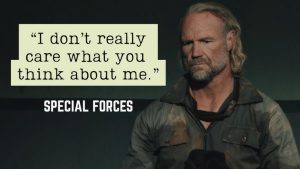
Kody chose to withdraw from the competition far earlier than many expected.
The man who had spent years presenting himself as the central pillar of a family of more than twenty people had reached his limit in a challenge specifically designed to test toughness and resilience.
His exit quickly became one of the most talked-about moments among Sister Wives fans.
The reaction across social media was immediate and intense.
Longtime viewers flooded discussion boards, online forums, and video comment sections with their opinions. Many fans believed the outcome confirmed suspicions they had held for years.
To them, Kody’s departure wasn’t surprising.
Instead, it seemed to reinforce a perception that the confident persona displayed on Sister Wives depended heavily on circumstances that favored him.
For years, viewers had debated Kody’s behavior within his marriages.
Some defended him.
Others criticized him.
Many arguments revolved around subjective interpretations of family conflicts and relationship dynamics.
But his performance on Special Forces felt different.
There was little room for interpretation.
The footage spoke for itself.
Fans could watch exactly what happened and form their own conclusions.
As clips from the show spread online, discussions intensified. Even people who had stopped watching Sister Wives years earlier found themselves drawn back into the conversation.
Many pointed out that Kody appeared strongest when operating within environments he understood and controlled. Once those familiar advantages disappeared, the image of invincibility became far more difficult to maintain.

What fascinated viewers most was the contrast between Kody’s behavior on Special Forces and the version of himself they had watched for years on TLC.
On Sister Wives, Kody often projected certainty.
He frequently positioned himself as the authority figure whose judgment should be trusted.
Even when relationships were deteriorating, he continued presenting himself as someone carrying enormous responsibility for the family’s well-being.
Yet Special Forces offered a dramatically different picture.
There, status meant nothing.
Authority had to be earned.
Respect came through performance rather than words.
And in that environment, Kody struggled.
Many fans began revisiting older Sister Wives episodes with a fresh perspective.
Scenes that once appeared to showcase confidence now looked different to some viewers.
His confrontations with Christine, Janelle, and Meri were reexamined through a new lens.
Instead of seeing a strong leader facing difficult circumstances, many viewers started seeing a man accustomed to operating within systems that reinforced his authority.
The parallels between his family struggles and his experience on Special Forces became increasingly difficult to ignore.
Christine’s departure represented one of the first major moments when Kody lost control of a situation.
She stopped participating in a dynamic that had defined their marriage for years and chose a different path.
No argument could change her mind.
No appeal to family tradition could reverse her decision.
She simply left.
Similarly, Special Forces removed Kody from an environment where he could rely on familiar strategies.
The result was another situation he couldn’t control.
Janelle’s journey reflected a comparable theme.
Over the years, she demonstrated remarkable independence and self-sufficiency. She built her own life, pursued her own goals, and repeatedly showed that she was capable of thriving without relying heavily on Kody.
For many viewers, this independence highlighted a deeper issue.
If the wives no longer needed a patriarch, what exactly remained of the patriarchal structure Kody had spent years defending?
That question lingered throughout the family’s ongoing transformation.
One by one, the foundations supporting Kody’s public identity seemed to weaken.
Christine left.
Janelle distanced herself.
Meri eventually acknowledged the reality of their fractured relationship.
And then Special Forces challenged the image of physical and mental toughness he hoped to reinforce.
Together, these events painted a picture of a man confronting the collapse of a role he had spent years performing.
What makes the story especially compelling is its broader message.
Reality television often encourages larger-than-life personas.
Participants become characters as much as people.
Over time, public figures can begin believing the stories they tell about themselves.
But eventually, reality has a way of testing those stories.
For Kody Brown, Special Forces became that test.
The competition presented an opportunity to reshape public perception and prove his resilience.
Instead, it exposed a gap between image and reality that many viewers had already begun noticing.
Today, Kody continues to navigate life within the world of Sister Wives and the ongoing conversations surrounding the Brown family. Yet the footage from Special Forces remains part of his public story.
New viewers discovering the series frequently encounter those clips alongside years of family drama, creating a powerful contrast that continues fueling debate among fans.
Whether one views Kody sympathetically or critically, his experience on Special Forces serves as a reminder that true tests of character often occur outside familiar territory.
In the end, Kody entered the competition hoping to prove he was tougher than ever.
Instead, millions of viewers watched as one of reality television’s most recognizable patriarchs encountered a challenge he couldn’t overcome—and the moment became impossible to forget.